Ce site web utilise des cookies pour améliorer votre expérience. Nous supposerons que cela vous convient, mais vous pouvez vous désabonner si vous le souhaitez. Lire la suite
Menu
Ultra Hiking

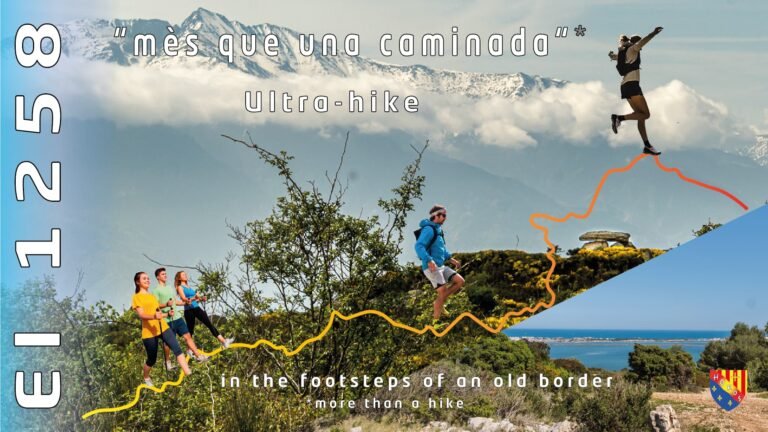
This is a fast hiking event, run solo or in teams of 2 or 3, male, female, or mixed, covering approximately 226 km with 8,000 m of elevation gain and 9,900 m of elevation loss. It follows the old border between the Col de Puymorens and Salses-le-Château on an unmarked course starting from Formiguères (km 42).
If a competitor in a team of 3 drops out, the two remaining runners may only continue after ensuring their teammate has been taken to a designated aid station and receiving authorization from Race Control.
If a competitor in a team of 2 drops out, both competitors must stop.
The goal of the Ultra-Randonnée is to complete the course at your own pace without exceeding the allotted time. This event is not considered a competitive race and therefore does not result in an official ranking. The timing system is designed to establish the speed/effort (VE)** achieved by the team, excluding stops at aid stations. This allows the team to be placed within the “finisher” system of the French Hiking Federation’s fast hiking benchmark, which recognizes four performance levels: gold (VE8), silver (VE7), bronze (VE6), and finisher (reaching the event’s time limit, approximately VE4).
It is open to participants aged 21 and over (born on or before September 6, 2005). No prior experience or performance level is required, as participants work in pairs or trios, ensuring sufficient safety conditions. The maximum number of participants for this event is capped at 300.
This event will take place during the 2027 spring break. Participants will have a maximum of 96 hours to complete this challenge and become a finisher.
*Definition of distance/effort: the distance of a course in kilometers plus the positive elevation gain in hundreds of meters. Example: I complete a 15 km course with 300 m of elevation gain, which makes a distance/effort of 18 kilometers/effort: 15 + (300/100) = 18 KE.
**Definition of speed/effort: the equivalent pace in km/h on flat ground, taking into account the positive elevation gain. It is calculated by dividing the distance/effort by the time in hours. Example: I cover 15 km and 300 m of elevation gain in 3 hours; my speed/effort = (15 + 300 / 100) / 3 = 6 km/h effort (VE6).
Specific conditions of the relay
A team of 5, all-female, all-male, or mixed, shares the course.
If a competitor drops out of a leg or exceeds a time limit, the competitors in the following legs do not start their leg.
The relay is a timed event; a team ranking is established at the finish. It is open to competitors aged 20 and over (born on or before September 6, 2006).
© OpenStreetMap contributors